Musk Therapy 1
Ever since people started learning about my earlier work, I've been asked the same question: will Musk Melange ever be remade? The honest answer is no. Not as an artisan blend, at least. And if you're looking backward at a single blend, you're missing the forest for the trees. I don't keep recipes or ratios. That matters even more when a blend like Musk Melange is built on vintage, highly aged materials, some tinctured for over a decade. Even with a formula in hand, I couldn't rebuild it. Raw materials like those simply aren't something I'll likely come across again. Rather than chasing a mirage, I wanted to explore the whole horizon of what musk can be. So I brought in a massive quantity of musk, vintage pods and powders alongside younger ones, set them to tincture, and began testing. Part of that stock found its way into releases like Kasturi Cola, while the rest was shaped with fresh accents to balance different profiles. Why call this series Musk Therapy? Because I want you to step back, look at the forest, and experience musk in formats you haven't encountered before. It is a multi-part exploration where each release offers a perspective on the same core material. Therapy 1 opens with two distinct paths: Ateeq: An attar built on a classic, vintage-styled take on musk. Cherry: An extrait spray featuring a realistic cherry replication structured over the musk core. More expressions will follow, each expanding a different corner of the landscape. If you've been waiting for Melange, I hope you'll start therapy here. This isn't a replacement. It's an invitation to see that Melange was only one tree in a vast forest, and there is a whole world of musk out there waiting to be smelled.
Kanafani
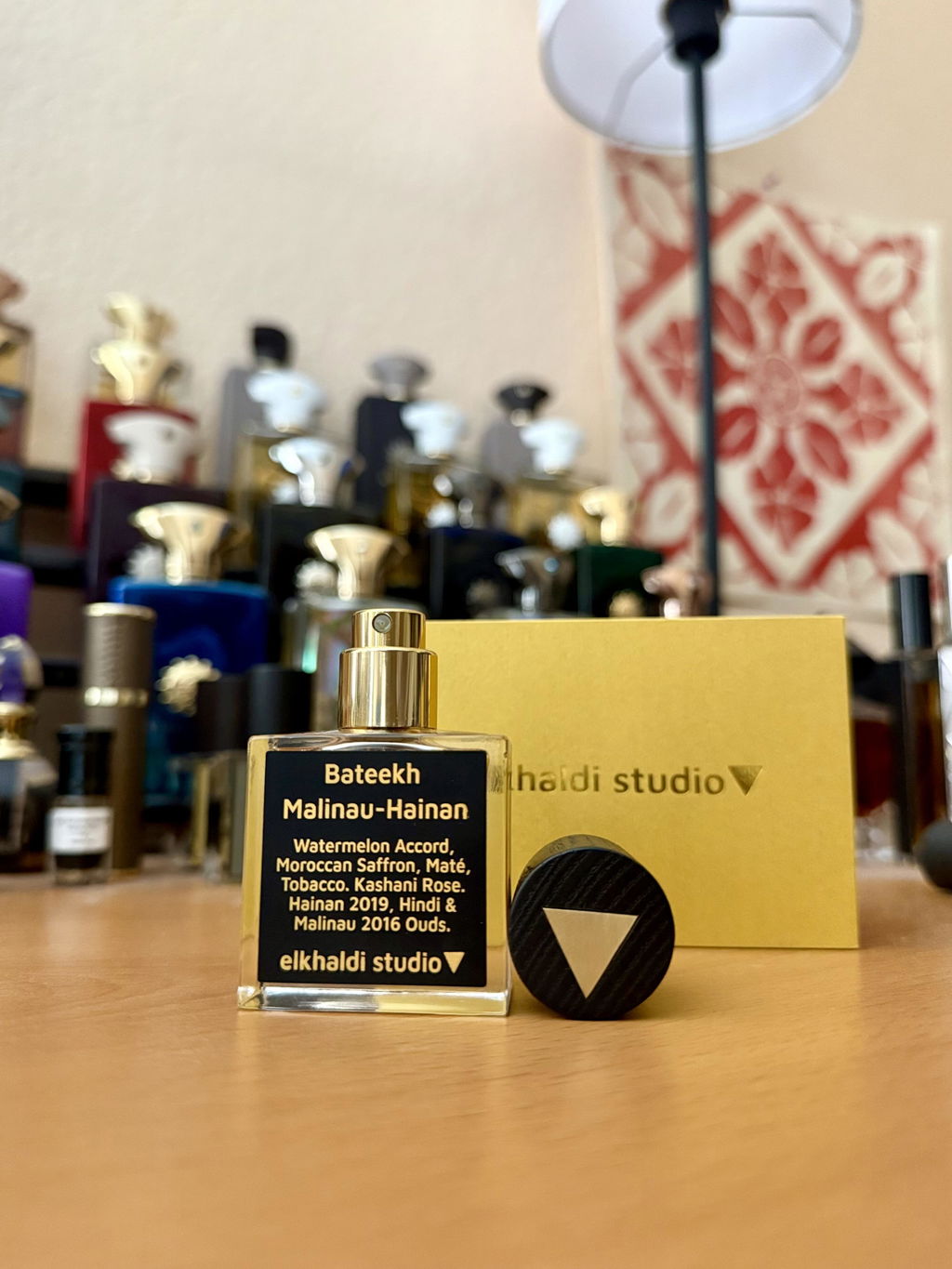
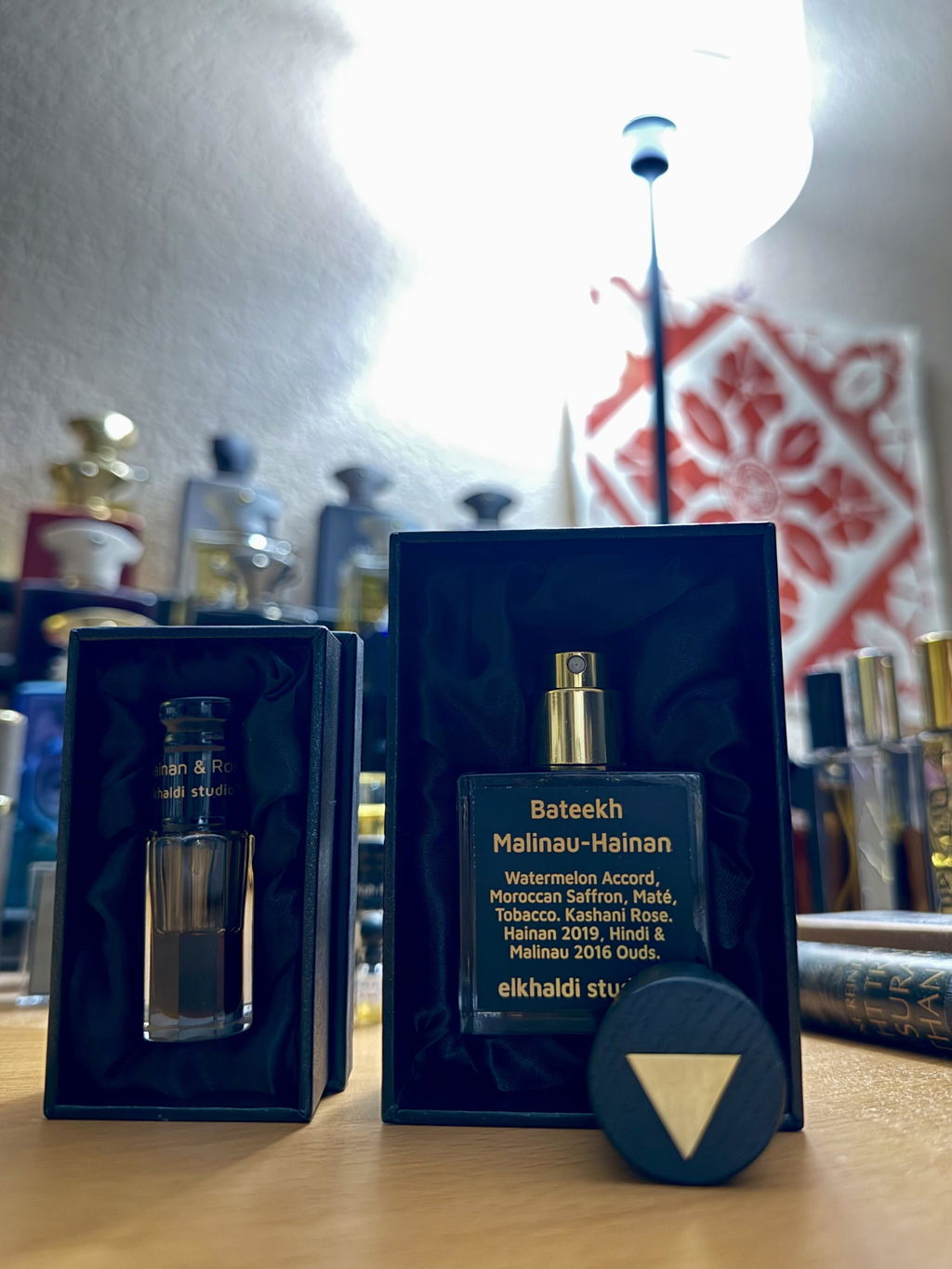
This release is dear to me. It carries the name of Ghassan Kanafani. Kanafani was born in Akka (what others know as Acre) in 1936. In 1948, when he was twelve, his family was forced from their home and became refugees, like hundreds of thousands of Palestinians that year. He grew up to become a novelist, journalist, editor, and teacher, and he spent every ounce of his talent telling the story of his people. My people. He wrote Men in the Sun, Returning to Haifa, and The Land of Sad Oranges, stories that still read like they were written this morning. In 1972, at the age of 36, he was assassinated in Beirut by a car bomb that also killed his seventeen-year-old niece, Lamees. Many people first met Kanafani through a short interview he gave in 1970 to Australian journalist Richard Carleton. Watch it and you'll see a familiar script, one that amounts to asking: why can't you just accept that a triangle has four sides? The questions were framed to make the occupation sound reasonable, to make the occupied sound unreasonable, and to turn a people's fight for their land into a quarrel between two equal sides. Kanafani doesn't take the bait. Calmly, precisely, he dismantles each framing. When he is asked why his side won't simply talk peace, he answers that what's being offered isn't peace talks but capitulation. When the conflict is called a "conflict," he names it for what it is: a struggle between the sword and the neck. That interview is a masterclass in refusing a narrative written by someone else. It exposes the double standard, the careful linguistic gymnastics, and the way colonial media casts itself as the reasonable voice in the room. Decades later, the script hasn't changed much. Neither has the need to see through it. Kanafani wrote about the oranges of Jaffa, their scent carried into exile as memory and grief. That idea has stayed with me: a smell can hold a homeland, and memory can be a form of resistance. It sits behind both blends in this release. The first is Bateekh, which I dedicated to Sliman Mansour. The watermelon he painted carried the colours of a banned flag. Here, it becomes a fruity watermelon blend, presented in many lights through its oud and rose editions. The second is Hainan Rose, which returns to the Hainan oud and rose of Qinan Rose. That blend carried the words of my late friend and comrade Tarek Al Ghoussein: "Maher, you learn things when you're ready to. Not when you want to." Coming back to those materials a few blends later felt like the right way to bring him into this release too. Sliman left a fingerprint of Palestinian resistance in colour. Tarek captured it in light and stillness, in quiet self-portraits. Kanafani expressed it in words. These blends are my attempt to give it scent. Kanafani gave his words, and ultimately his life, to our story. The least I can do is keep his name alive.
Nisreen
This release marks two small changes. Co-authored is now part of Unscripted. Co-authored grew out of Unscripted to begin with, and the unscripted quality is inherently there, so keeping them separate stopped making sense. Every product page already names the vendor who holds the stock and the artisans behind it, which is most of what a separate category was carrying anyway. Releases now have names. I used to lean on a hierarchy — bases, themes, genres — as a conceptual guide, both for you browsing the site and for me making the products. I wrote about that in my taxonomy piece. The longer I sit with it, the more I feel that a single release name is enough. It’s looser, less structured, and easier to hold in your head. A release can draw from different bases or genres, curated or unscripted, and still come together under one name. The first release is Nisreen. The name was inspired first and foremost by a ten-year-old Palestinian girl in Gaza whose account I’ve been following. Check out Nisreen’s page on Instagram. She posts about the challenges she faces, but mostly about how she gets through her days — how she, other children her age, and Palestinians across Gaza are surviving a genocide we watch unfold on our screens every day. And she does it with a smile. That’s what made her my inspiration: Palestinians can never be broken. This is my tribute to her. I’ve never met her or spoken with her, but that’s beside the point. If she ever comes across this site, I hope she finds some comfort in knowing that her presence, in however small a way, inspired something here. The meaning of the name felt fitting too. In Arabic, Nisreen (نسرين) refers to the wild rose. It felt right for the kind of products this website offers.
July The 15th
This time, my goal was to offer a much broader range of aromatic profiles—from roses and florals to animalics, fruits, citruses, and beyond—so there's something that speaks to a wider variety of noses. I've also done everything I could to keep prices as accessible as possible without compromising on the quality of the materials. For those who enjoyed my earlier work, Castore Rouge is probably the closest in spirit to my first releases. Nightfall is a balanced composition built around jasmine, neroli, leather, and fruit, with each element supporting the others without dominating. If you're drawn to greener compositions, Civet Prestige is for you. Creamy white florals, restrained animalics, and Hindi oud come together to create a rich yet elegant composition. Al Bahar explores a bright citrus opening over an oceanic, saline heart, resting on a subtle oudy foundation. And finally, Ananas Tabac is exactly what the name suggests: a juicy, sweet pineapple paired with a rich tobacco base, accented by restrained metallic nuances that add character without overwhelming the composition. I'm also excited to introduce artisan handmade wooden caps for the 30ml and 50ml bottles, each individually handcrafted and inlaid with natural mother of pearl. No two caps are exactly alike, making every bottle just a little more unique.
Blue Roast
Many of my blends come to life through the slow, intentional mingling of oils, while others emerge fully formed from ideas I carry in my mind. This collection is one such concept—an exploration of Blue Lotus, Coffee, and Black Ambergris. Sourced from Sri Lanka, Hawaii, Thailand, and India, Blue Lotus introduces an airy and aquatic profile, true to the nature of water lilies. This contrasts beautifully with the deep, roasted richness of Coffee and the oceanic, mineral nuances of Black Ambergris. This base is anchored with a trio of ouds—Manipuri, Kalakassi, and 20-year-aged Cambodian oud—added in subtle amounts to depth and longevity without assertion. You might ask, is the blue lotus noticeable? Is it not exorbitantly expensive? I would argue that it is indeed noticeable, and yes, it is expensive. But in perfumery, there are many techniques a perfumer can use to amplify certain facets of a note while incorporating supporting elements to build a complete composition. The notes I found that blend beautifully to achieve this effect are Black Ambergris, Fir Balsam, and Coffee. It is an entourage of notes, not just one. But Blue Lotus is certainly given special treatment, and I hope you will find that it stands at the center of the composition. This was Blue Roast.
Ghazali
The Ghazali moniker began when I discovered Al Hashimi's SP1, which ignited my desire to explore its potential. Special Reserve No.1 was the first creation, a blend of Sultan's Rose (2008) and Taif Rose (2012), chocolatey deer musk, ambergris, and Assam oud. This composition is a beautifully balanced marriage of floral richness, the soft barn notes of Al Hind oud, and deep floral and balsamic musk from Kashmir and Siberian deer musk. The name "Ghazali" came about from a funny misunderstanding. A friend who received an early version of my first Ghazali perfume misread my handwriting and thought I had written "Ghazali" instead of "Ghalia." I kept correcting him until, eventually, I caved and said, "You know what, Ghazali it is." The first version of Ghazali, with its rich mix of saffron, rose, chocolate, and musk, was well received, which inspired me to further explore variations, leading to the expansion of the Ghazali moniker into a series. At the time of this website release, I have a few attars available for your to choose from--each going a different direction. This was Ghazali.
Ambergris Spectrum
This is my first exploration of ambergris-based compositions with 1 oud blend, developed over seven months of collecting and refining various ambergris tinctures and macerations. Throughout this process, I experimented with different roses, florals, and complementary notes, pushing ambergris in multiple directions—gourmand, floral, earthy, woody, and fruity—to uncover its full expressive range. This was Ambergris Spectrum.
Nectar
This project started nearly five months ago, initially envisioned as a sandalwood perfume crafted around five distinct varieties. Then came osmanthus—both French and Chinese—followed by two rare vintage oud oils I sourced from collectors: Sumbawa and Kalimantan. Honeysuckle joined the composition next, alongside Oolong Tea and a castoreum infusion I left to mature for almost a year. You get the idea! Months later, I acquired five grams of vintage civet and five grams of vintage musk, both decades old. They smelled heavenly. Their inclusion transformed the blend, giving it a direction of its own—some kind of sprint, if you will. Then came a dark Hyraceum absolute, coupled with wool so soft in smell, like it probably was to the touch. At this point, the last tola of a vintage 2014 Pursat oud I scored from Anas of Al Hind Oud found its seat. Now, I felt I had a base developed enough to be taken in different directions, allowing both cohesion and the unique identity of each variant to come. This was Nectar.