Reviews. Unfiltered.
Featured Blog Posts
Why Genres?
Why did I gravitate towards Genres? And why are their formulas so elaborate—built like full compositions rather than simple accords? The answer is interaction. Materials don’t behave independently in a blend. Nothing is additive. Everything is contextual. Each addition reshapes perception—brightness, texture, diffusion, contrast. A material that seems minor on its own can rewrite how everything around it is read the moment it enters the structure. Formulation, then, is a system in motion. Every intervention changes the ground it stands on. You are not working inside fixed conditions. You are moving them as you go. In perfumery, a Genre is infrastructure—an environment of interacting conditions rather than a fixed formula. Some structures are too sparse to hold complexity. Introduce a material into a simple base, and it disappears or flattens. There is nothing for it to push against. But place it inside a Genre, and it meets resistance, contrast, and structure. It becomes legible through interaction. This is why Genres are built like full compositions. They are not placeholders for ideas—they are complete fields designed to absorb change without collapsing. Any blend built from a Genre carries that structure forward. The signature is already embedded—in the way tension holds, how contrast resolves, how space is carved. A Genre is ultimately a strategy for reintroduction without repetition. A way to return to a familiar climate, introduce a new variable, and let both the system and the material reshape each other in real time. This is the lure of Genres for me. They are more complex, more demanding to build, and carry higher risk—both in failure and in the risk of being constrained by their own internal logic. I don’t plan to build everything through this lens, but I think it is worth exploring in the next few projects.
Green
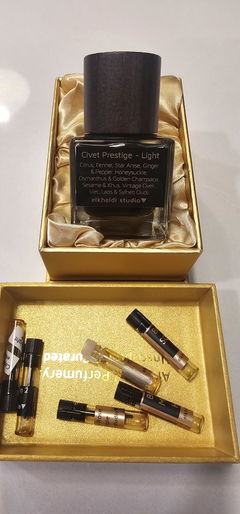
Early in my journey, I became curious about the idea of the chypre. Or more accurately, I wondered if I could actually make one I’d want to wear. I went through countless attempts chasing that classic ghost of citrus, green, wood, and moss. Nothing ever felt quite right. Some of my early iterations were literally labeled “Not Chypre” and “Still Not Chypre.” If you’ve been around early in my journey, you might even have a stray sample of those sitting in a drawer somewhere. I wanted something green, peppery, and slightly smoky—masculine, but soft around the edges. A bright citrus opening that doesn’t feel hollow or detached from what follows, and a quiet glimpse of Luban hidden deep within the composition. The “green” here isn’t built on classical mossy accords (although a slight amount of oakmoss was used to maintain some familiarity). What actually builds the infrastructure is armoise, pomelo, petitgrain, eucalyptus, kewra, and khus, with choya, patchouli, seaweed, and oakwood. Trace amounts of castoreum, civet, and musk are used strictly as fixatives—there to texture and bind the composition rather than to announce themselves. While Green leans heavily natural, I also decided to introduce aroma chemicals into the mix. Why? Because certain scent molecules do not exist on their own in nature. Or, if they do exist, they never arrive isolated; they come buried under a host of other naturally occurring molecules that dilute their impact and mute their specific nuances. By utilizing isolated aroma chemicals, I can target those exact, sharp characteristics without the baggage of the rest of the plant's native material pulling the system out of balance. More importantly, it gives room for entirely new interactions to explore. This is not purely a cost consideration—it is an intentional, scent-driven choice. Just like other Genre ideas, this infrastructure works as a perfume on its own. But I want to use this environment to release various iterations with different co-stars—whether single materials or entirely new accords—and let the system and the guests rewrite each other.
My Taxonomy
This is how I organize my work in perfumery as I strive to remain clear about intention, structure, and what each composition is meant to be. My work, so far, moves through three strategies which I refer to as Compositions: Solos, Bases, and Genres, shaped across three ways of making, which I call Signature: Unscripted, Curated, and Co-authored. Signature Unscripted is discovery-led. I work directly with materials without a fixed formula. The composition develops in real time through interaction with the raw materials themselves. Curated is integrity-led. I seek and select only high-quality work from trusted artisans and collectors I have built relationships with over time. Everything is offered exactly as I receive it—unaltered, uncompromised, and in its original form. Co-authored is collaborative. I set the initial direction, then hand it to another perfumer to reinterpret or develop further. Think of it like a kitchen: I make the dough, they take it and shape it into what they see fit. Composition (Architecture) Solos standalone work. No shared base, no continuation, no structural link to other perfumes. Each piece exists fully on its own. Bases came from my curiosity to work from a shared foundation as a point of departure. Instead of starting from scratch every time, I use a common base as a branching structure—allowing me to explore different directions from a single olfactive starting point. It creates a controlled divergence space: one root, many paths. Genres sit between repetition and reinvention. It came from a different need entirely—the request for continuity. People often want a perfume to return, to be “the same again,” but I generally aim not to repeat myself in a literal way. Genres allow me to revisit an idea without freezing it. The core narrative remains recognizable. It is a way to stay in dialogue with an idea without locking it into stasis. Extensibility Orthogonal to Signature and Composition is the idea of Extensibility. This concept evolved from an earlier approach I called X Editions, where “X” represented whatever a customer wanted to add to a blend. Over time, that open-ended flexibility became too loose, and I moved toward a more refined and constrained set of controlled additions. Having worked on a few releases, I realized that certain blends—specific implementations of compositions—can naturally accommodate additional notes, either to amplify an existing profile or to introduce a complementary direction. The goal is not to transform the perfume into something else, but to extend its language without breaking its identity. This idea comes from my research in human-computer interaction and modular systems thinking, where systems are designed as templates for interaction rather than fixed objects. In the same way, these perfumes function as structured frameworks—allowing variation and personal direction while preserving core identity. Intuition This framework reflects how I currently understand my work and how it evolves. Often intuition leads first, and only later reveals its structure—almost as if it is saying: "this is what I meant all along." I am simply putting that into words.
Art Not Fiction
For some reason, it’s widely accepted that consumers can demand suppliers be “neutral”—usually expressed as “stay out of politics.” I outlined my take on this in Art with Bias, but recent conversations make me feel I should be more blunt: I reject that fiction; particularly at a time when official channels continue to suppress, ignore, or outright shut down voices that don’t chant to power. Neutrality risks becoming complicity; especially when demanded by those uncomfortable with relaying voices of the oppressed. Art has never been neutral. Commerce has never been neutral. Media, design, entertainment—all are soaked in ideology, even when pretending otherwise. So no, I will not strip the politics out of my reality. If that makes people uneasy, it should. Recently, a few members from my small but growing community told me some people had left my brand because I am being "political". I expected it, but I am indifferent. In fact, through the lens of human dignity we're all entitled to, I am glad. I am glad that my blends are not used to adorn their world—a world where justice is rationed to the powerful and privilege is disguised as entitlement. For me, it is not about comfort or convenience. It is about whether I am willing to bow to the pressure of profit, or to the expectations of those whose moral compass follows what's comfortable. I wonder if they, who profess the “separate politics from business" argument, realize that taking a stance is as much politics as not taking one. Silence is a choice. Indifference is a choice. I made mine. They can make theirs. Yes, I’ve had customers leave. I’ve had social media accounts banned. I was let go from a job for my unwavering stance against war-for-profit and colonization. That’s a price. And it pales compared to what’s going on. The worth is greater: refusing silence and standing with the collective voice that is shifting the narrative on Zionism. Palestine was nearly forgotten. The struggles that the Nakba generation endured to raise the next one were nearly erased. Don’t be fooled into thinking it started in—or because of—October 2023. It began more than 75 years ago, and has continued ever since—with more gore, more horror, more entitlement, and more evil. It is nothing short of demonic. I am open to discussion. We can talk history, theology, logic, and all else. But if someone insists on my silence, I have nothing further to say except: “You’re welcome to explore the work of other perfumers." For those who celebrate the independence of their state, here are a few questions for you: Do you also celebrate the resistance, which made it a reality? Do you teach your young about the sacrifices of the previous generations? Would you not write about and speak against the exploitation and colonization of your state? I am not asking you or anyone to take a stance for Palestine. I am only pointing out that you should not expect me to abandon mine. If I have a voice, a platform, and the ability to be vocal. Then, God willing, I will. For me, Palestine is worth it. EDIT Nov 11 2025. I came across this short today, which I felt very much speaks to the same irony: Maher
Take On Perfumery
Perfumery as Intentional Improvisation I view perfumery as a dynamic art form—one rooted in intentional improvisation. Fragrances evolve as individual notes interact, accords emerge, and elements blend into a cohesive whole. True artistry, I believe, flourishes when it’s free from rigid formulas, constraints, or imposed expectations—when it’s created unscripted. I began crafting perfumes to evoke the scents I longed for but couldn’t find. To me, fragrance is like a puzzle—both a mental and olfactory challenge, balancing structure with adaptability. I often draw inspiration from systems theory, where modularity and flexibility guide my process. Each scent becomes an evolving base, open to reinterpretation. Other times, it’s pure experimentation—an exploration of possibilities in pursuit of a goal. It’s a challenge I welcome, every single time. Deterministic, Not Predetermined While recipes and formulas serve their purpose in replicating an idea, they can never fully capture the soul of an artisanal creation. Documentation alone cannot convey the nuance, intention, or flow of the creative process. Intentionality in my work isn’t about following a predetermined formula—it’s about deterministic exploration: making deliberate, thoughtful choices as a fragrance takes shape. My process prioritizes cultivating intuition—an essential skill in this craft. This isn’t just an artistic choice; it also serves practical purposes: Every batch is inherently unique—its limited nature defines its artisanal value. It fosters continuous exploration, encouraging adaptation to diverse preferences and evolving trends. It sustains a thriving secondary market, where scarcity and individuality make secondhand ownership just as meaningful as the original purchase. Personalization: Making the Scent Your Own Imagine dining at your favorite restaurant and being told you can’t have salt and pepper—frustrating, right? I believe fragrance should be just as personal. Whether you want to enhance a blend with complementary oils, experiment with oils I provide, or incorporate your own materials, I’m happy to assist. I charge only for the oils, shipping, and a minimal fee for my time—even for a 15ml bottle. What matters is that you receive a perfume that truly reflects your preferences. Think of it like a bespoke tailor—adjusting every detail to fit you perfectly. Transparency and Full Disclosure My descriptions focus on intent—what I set out to achieve with each project. I aim for them to remain objective, even quantifiable, grounded in experiences or sensory references others can relate to—almost like universal units of measure. I also provide pre-release samples to trusted reviewers (aka frag/oud-heads), allowing them to share independent impressions without interference. Trust is earned and fragile, so I never influence their assessments. Their credibility is on the line as much as mine. On Sample Sets Whenever possible, I offer samples—though availability is limited due to the small-batch nature of my work, and sometimes due to logistics and timing. I work iteratively and sequentially on multiple blends in parallel, but not all of them mature at the same pace. I won’t include a blend in a discovery set just to complete one; if a fragrance isn’t ready, it waits. Likewise, I can’t always delay ready releases, as revenue from sales often helps fund and complete ongoing projects. On Pricing Cost does not disappear when growth becomes a goal. Here’s why: When I’m small, I purchase ingredients in small quantities—often at higher prices. As production scales, I can source materials in larger volumes and reduce certain costs. However, this shift introduces new layers of expense: producing more bottles, managing logistics, hiring help, handling shipping, marketing, and distribution. In other words, a lower material cost does not directly translate into a lower bottle price—because other operational costs rise in parallel. Liquidity is also essential. Each project I work on requires time and financing—sometimes months of preparation before a single drop is ready. Cash flow sustains that cycle. Think of it like the rhythm of the seasons: periods of creation, maturation, and release, each requiring resources to bring the next to life. Then there’s the question—why are good oils expensive?The answer lies in the nature of the materials themselves. These are often rare, labor-intensive ingredients, sourced through long and delicate supply chains that involve skilled, often seasonal workers. Each drop represents the collective effort of many hands and the unpredictable conditions of nature. Unlike gold, whose price is based on a universally recognized and measurable purity, perfumery materials exist in a much more complex world. Quality is subjective, and value is shaped by artistry, rarity, and interpretation. This is why prices vary widely from one perfumer to another. Ultimately, a customer chooses a perfume not for the raw material cost but for the artistry—for the creative vision that gives those materials form and meaning. Much like how you don’t buy a phone merely for the metal or the pixels that make up its display, but for the experience it offers—the years of refinement, the skilled hands, and the collective expertise that brought that experience to life. You are not just paying for what exists today, but also for the craftsmanship, research, and growth that will shape what comes next. In conclusion.. I’m deeply grateful that my work has resonated with members of the perfume community. Maher
How I got here
I was a kid who couldn’t stop creating — filling school books with drawings of TV cartoons, hearing a theme once and playing it perfectly on a keyboard, both hands, no training, just by ear. I sketched life-like portraits of my teachers in class and went home after hanging out with friends to recreate a meal I’d tasted at a tiny street food shop in Sharjah. I’ve always been driven by curiosity, trying to understand how sound, flavor, or form come together to create a complete experience. That curiosity carried me into architecture, where my graduation project focused on decoding urban patterns and expressing them as abstract designs. I spent months observing how people moved through space, learning how structure can quietly shape experience in powerful ways. Later, I pursued graduate studies in computational design and generative systems, where I learned how small changes can create wide variations, how complexity can be explored, organized, and refined, and how systems can be modeled from a user-interaction standpoint. Taking those conceptual frameworks, I worked in startups and engineering teams across construction, automotive, and aviation. I had the opportunity to build tools for both large and small teams, for production operations as well as experimentation. This taught me the value of iteration: build, test, refine, repeat. I bring that same process to perfumery, where every release is a step toward a clearer, more precise expression of an idea. That same mindset eventually drew me into perfumery. I started by buying artisanal blends and often felt the desire to add a few notes I thought they needed. That impulse to adjust and refine quickly became something deeper. I began studying raw materials, experimenting with structure, and realizing how even the smallest tweak could change the entire mood of a scent. I view creating perfume as a problem-solving activity. I start with a goal inspired by an idea and explore different ways to reach it — sometimes taking the most direct path, and other times experimenting freely, with a subtle influence of optimization and search algorithms guiding my choices. A blend might serve as an extensible base to be built upon or reinterpreted, or it might be a singular, self-contained composition designed to shift perception — taking the front row in one edition and the back row in another. I’ve tried to bring this modularity directly to the end user through X-editions on my website, creating a system of mass customization where each person can shape and explore their own experience. Each blend becomes a deliberate exploration within a framework — a balance of design, experimentation, and taste. Even this website, elkhaldi.studio, reflects that mindset. I continuously rebuild and refine it — not just for design, but to make it a better reflection of how I work and think. That’s my story. Maher