I’ve always moved between building bases and creating individual blends. Bases—collections of notes and accords—serve as seeds, giving life to multiple blends that share a root but grow in their own directions. Early on, I experimented with X Editions, a way to let customers shape a scent by amplifying or even adding notes not present in the original blend. In theory, it was an exciting experiment in mass customization. In practice, there were just too many “knobs to turn.” The process felt overwhelming rather than empowering, and I realized complexity can sometimes obscure intention.
From that came Add-ons. By simplifying choices to a few focused options with clear guidance, I created a gentler entry point for customization. Add-ons are a bridge—a way for customers to gradually participate in shaping a fragrance, building the confidence to explore semi-bespoke or bespoke scents. It was a step toward collaboration, without losing clarity or identity.
Alongside this, I began thinking about Genres. A Genre, for me, is a collection of profiles that give a scent its character, while a Base is a collection of notes—the raw materials. If you like software analogies, a base is a library of components, and a genre is a framework that shapes how the system behaves. Notes form accords, accords form profiles, and profiles define a genre. Genres let me honor familiar directions that people enjoy while still leaving room to explore new territory.
Today, I’m developing five core genres: Purple-Gris, Musk, Leather, Resin, and Cola. Each draws from past blends that resonated with customers, but none are recreations—they are frameworks for new expressions. Alongside these, I continue to create one-off blends, explorations that exist outside any framework. So, in a way, it's: One-Offs ⊂ Bases ⊂ X Editions ⊂ Add-Ons ⊂ Genres
All of this is shaped by my background: trained equally in the arts and computation, I’ve worked across architecture, software, and manufacturing. I love structures, patterns, taxonomies, modularity, and reuse, but I also thrive on freestyle creation. Perfumery, for me, is where these impulses intersect—a space where rigor and intuition coexist, and where every scent can both honor tradition and explore the new.
So far, I've mostly relied on my own judgement, as the maker, to decide how best to present a scent. But many of you have asked for lighter versions: lighter on clothes, lighter in presence, and lighter on the wallet. After all, a blend is made to be worn — by you!
I've always tried to give you a choice, so each blend can become your own. That started as X Editions, where "X" was whatever you wanted to add to a blend, and over a few releases it became the more focused set of Add-ons I offer today.
Some blends want to stay dense, and some want to stay light. So I'll be revisiting some of my current blends to make lighter versions of them that, to my nose, are still concentrated enough to give each blend what it deserves.
To drive the point home on concentration, let me clarify a few things.
You experience a perfume when its scent molecules physically reach the receptors in your nose, either because you sniff your skin up close or because the molecules have drifted into the air around you. That drifting is what we call projection.
But reaching your nose isn't enough. You only notice the molecules your receptors can detect. Think of it like Lego: a molecule has to click into a receptor that fits it. Each receptor fits a range of shapes, and each molecule fits several receptors, so every scent is a pattern of pieces clicking into place. Not everyone has the same pieces. Some people can't smell certain molecules at all, and certain musks are a well-known example. That's one reason the same blend can smell different to you than to someone else.
What the scent sits in matters too. In a spray, the scent is dissolved in alcohol. Alcohol evaporates within minutes, so a spray opens fast and fills the air right away. Once the alcohol is gone, the scent molecules keep leaving your skin on their own, each at its own pace: the lightest first, the heaviest last.
In an attar, the scent sits in oil. Oil barely evaporates, so it holds the molecules back and lets them go slowly. That's why attars sit closer to the skin, project less, and can last a long time.
Warmth speeds up both. A blend behaves differently on a hot day, and on your wrist compared with your shirt.
Which brings me to a trade-off. A molecule is either on your skin or clothing, or in the air. There's no Schrödinger's cat business in perfumery; it can't be in both places at once. For the same amount of perfume, the faster it leaves, the more you smell it now and the less is left for later. Slower release means softer projection that lasts longer.
It's a trade-off, not a strict rule. Wearing more, or wearing a stronger blend, can give you more of both.
Then there's concentration itself. Think of scent molecules as people in a room. A crowded room is loud, noticeable, and slow to empty. A room with fewer people is quieter, airier, and empties sooner.
But the people aren't all alike. Some leave almost as soon as they arrive; others stay until the end. With natural materials, who is in the room matters more than how many. The same material can behave differently depending on how it was processed or how long it has aged. That's why a number on a label tells you so little, and why I judge a lighter version by nose, not by percentage.
A lighter version is softer, less dense, and fades sooner. It also has an upside: some materials show different sides of themselves when they have more room. A lighter version isn't just a weaker copy. It can reveal facets that the denser one hides.
Where you wear a scent matters too. Your skin has its own chemistry: its natural oils, moisture, warmth and pH all interact with the blend. Drier skin often lets a scent fade faster, while oilier or well-moisturised skin tends to hold it longer. Even the condition of your skin on a given day plays a part. That's why the same blend can wear differently on you than on someone else, and even on you from one day to the next.
If you want a more even, predictable experience, try your clothes. Fabric has no chemistry of its own to change the scent and no body heat pushing it off, so a blend tends to smell closer to how I made it, and it often lasts longer too.
That's another reason I'm making lighter versions of the current drop. Many of you wanted to spray them on light-colored shirts, and the denser versions, rich in dark natural materials, can mark pale fabric. The lighter versions are much gentler on clothes, but natural materials can still leave a trace, so test on a hidden spot first.
When someone asks me what the concentration is, my answer is usually "enough." Now there's simply a "lighter enough."
This release marks two small changes.
Co-authored is now part of Unscripted. Co-authored grew out of Unscripted to begin with, and the unscripted quality is inherently there, so keeping them separate stopped making sense. Every product page already names the vendor who holds the stock and the artisans behind it, which is most of what a separate category was carrying anyway.
Releases now have names. I used to lean on a hierarchy — bases, themes, genres — as a conceptual guide, both for you browsing the site and for me making the products. I wrote about that in my taxonomy piece. The longer I sit with it, the more I feel that a single release name is enough. It’s looser, less structured, and easier to hold in your head. A release can draw from different bases or genres, curated or unscripted, and still come together under one name. The first release is Nisreen.
The name was inspired first and foremost by a ten-year-old Palestinian girl in Gaza whose account I’ve been following. Check out Nisreen’s page on Instagram. She posts about the challenges she faces, but mostly about how she gets through her days — how she, other children her age, and Palestinians across Gaza are surviving a genocide we watch unfold on our screens every day. And she does it with a smile.
That’s what made her my inspiration: Palestinians can never be broken.
This is my tribute to her. I’ve never met her or spoken with her, but that’s beside the point. If she ever comes across this site, I hope she finds some comfort in knowing that her presence, in however small a way, inspired something here.
The meaning of the name felt fitting too. In Arabic, Nisreen (نسرين) refers to the wild rose. It felt right for the kind of products this website offers.
This is how I organize my work in perfumery as I strive to remain clear about intention, structure, and what each composition is meant to be.
My work, so far, moves through three strategies which I refer to as Compositions: Solos, Bases, and Genres, shaped across three ways of making, which I call Signature: Unscripted, Curated, and Co-authored.
Signature
Unscripted is discovery-led. I work directly with materials without a fixed formula. The composition develops in real time through interaction with the raw materials themselves.
Curated is integrity-led. I seek and select only high-quality work from trusted artisans and collectors I have built relationships with over time. Everything is offered exactly as I receive it—unaltered, uncompromised, and in its original form.
Co-authored is collaborative. I set the initial direction, then hand it to another perfumer to reinterpret or develop further. Think of it like a kitchen: I make the dough, they take it and shape it into what they see fit.
Composition (Architecture)
Solos standalone work. No shared base, no continuation, no structural link to other perfumes. Each piece exists fully on its own.
Bases came from my curiosity to work from a shared foundation as a point of departure. Instead of starting from scratch every time, I use a common base as a branching structure—allowing me to explore different directions from a single olfactive starting point. It creates a controlled divergence space: one root, many paths.
Genres sit between repetition and reinvention. It came from a different need entirely—the request for continuity. People often want a perfume to return, to be “the same again,” but I generally aim not to repeat myself in a literal way. Genres allow me to revisit an idea without freezing it. The core narrative remains recognizable. It is a way to stay in dialogue with an idea without locking it into stasis.
Extensibility
Orthogonal to Signature and Composition is the idea of Extensibility. This concept evolved from an earlier approach I called X Editions, where “X” represented whatever a customer wanted to add to a blend. Over time, that open-ended flexibility became too loose, and I moved toward a more refined and constrained set of controlled additions.
Having worked on a few releases, I realized that certain blends—specific implementations of compositions—can naturally accommodate additional notes, either to amplify an existing profile or to introduce a complementary direction.
The goal is not to transform the perfume into something else, but to extend its language without breaking its identity.
This idea comes from my research in human-computer interaction and modular systems thinking, where systems are designed as templates for interaction rather than fixed objects. In the same way, these perfumes function as structured frameworks—allowing variation and personal direction while preserving core identity.
Intuition
This framework reflects how I currently understand my work and how it evolves. Often intuition leads first, and only later reveals its structure—almost as if it is saying: "this is what I meant all along."
I am simply putting that into words.
Where:Personal / home , Social / outings , Small groups / personal space
When:Evening
Frequency?:Weekly
How accurate was the description in your experience?:
Very different
Spot on
Nightfall Neroli
Opens with the notes of peach and osmanthus, very bright and lively. Then comes a melange of Jasmines to round up the sweetness from the opening and add sophistication. And through it all is the backbone, grounding oud and leather that is noticable throughout the journey. Kudos Maher for this wonderful and rich experience!
Where:Personal / home , Small groups / personal space
When:Evening
Frequency?:Weekly
How accurate was the description in your experience?:
Very different
Spot on
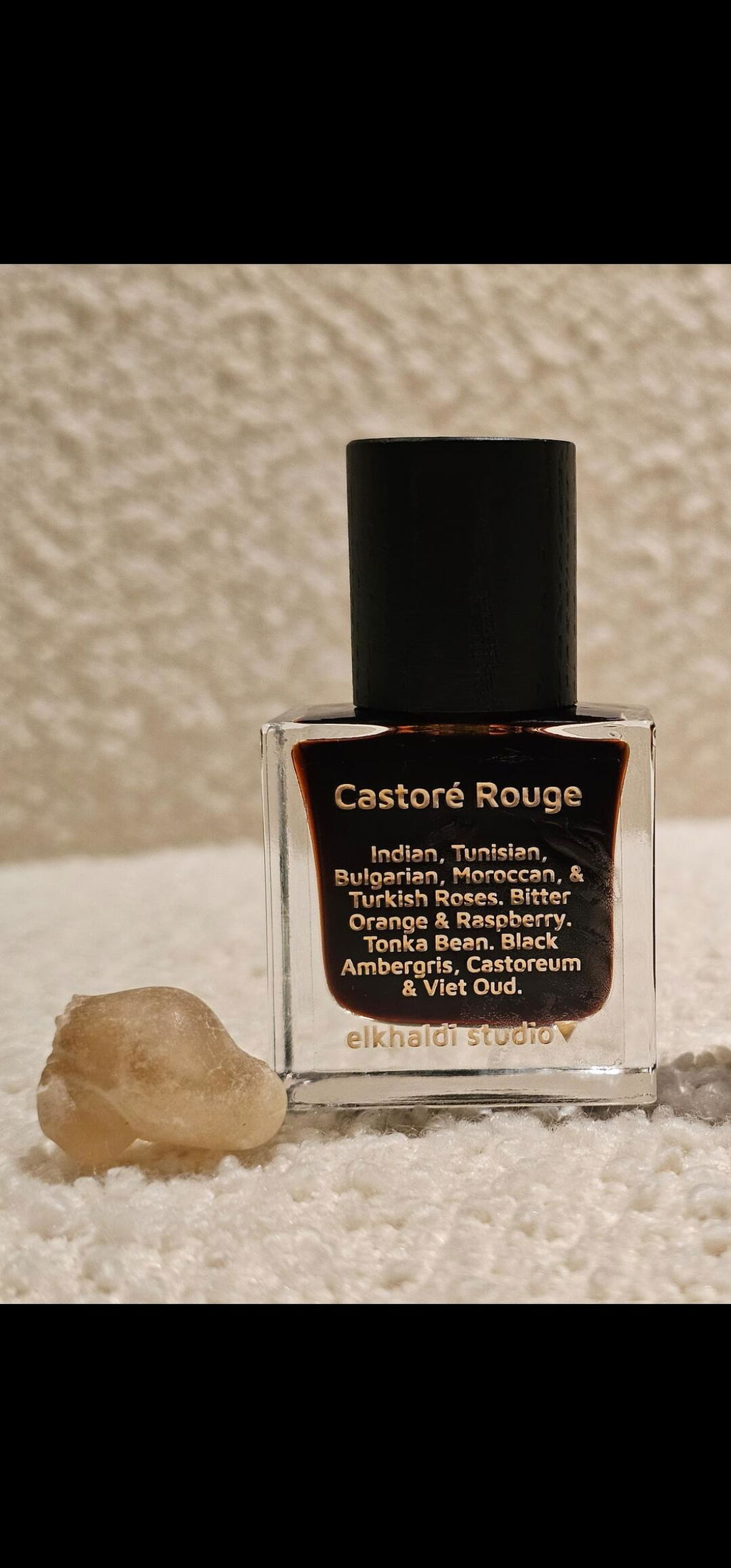
Castore Rouge
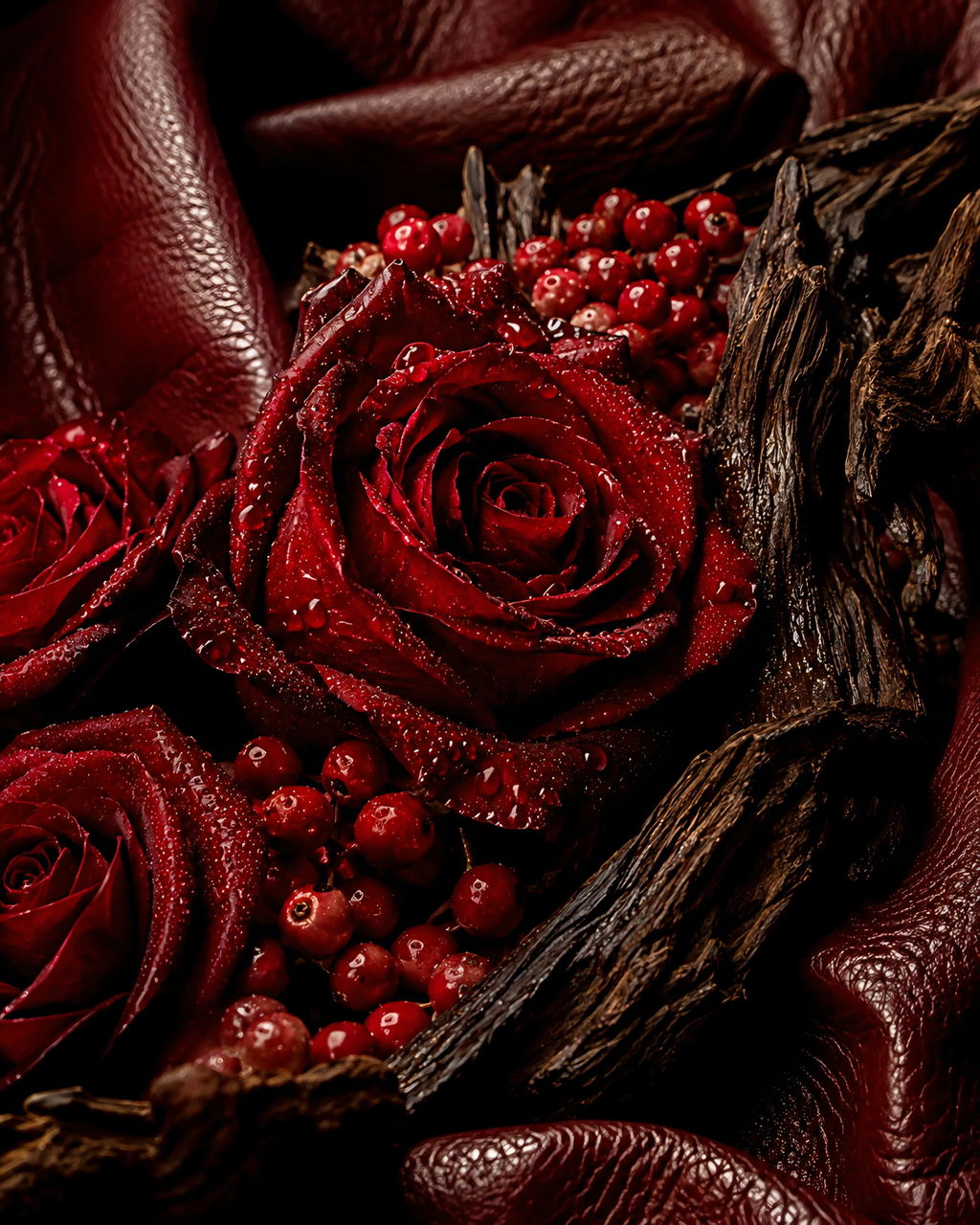
Castore Rouge is an opulent composition. Opens with vibrant roses and tart raspberry. Oud, Castoreum, Ambergris work together to ground the composition and give it a strong foundation.
Dark and vibrant, sweet and sour. Overall a well balanced composition where each ingredient plays its role but doesnt overwhelm the others