Leather was one of the first materials I ever experimented with. You might have seen a couple of bottles floating around under the name Scarlet Leather. Back then, I was new — curious, learning, and admittedly unsure. The leather I used was entirely synthetic. I wasn’t building a philosophy; I was trying to understand structure, projection, and texture. How something tactile could exist as vapor. It was experimentation in its purest form.
Over the many blends I’ve since released, my understanding of materials deepened. Blending became less about layering notes and more about control, balance, and intention. What notes appear when, how they transition, and how they land.
Up until recently, I viewed leather as an accord. That changed when I got a sample of CO2-extracted Night-Blooming Jasmine. Sure, it had the Jasmine character — floral, a little weighted — but it wasn’t indolic. It was creamy. Leathery creamy. Suddenly, gears in my brain started turning. I envisioned how this could become a leather-Jasmine project.
What began as a single blend turned into the seed for a leather genre: something resinous, creamy, and versatile enough to work not just with Jasmine, but with Rose or other materials as well.
I remember joking to a friend that it feels like a luxury leather seat — polished, warm, lived-in. Not rugged. Not aggressive. The kind of leather that doesn’t need to prove itself.
And yes, I realize it might be a bit (or a lot) irrational to use Night-Blooming Jasmine as a material to build a core leather accord for other blends. But if you read up on perfumery, you’ll see that many masterpieces use exotic materials to create a robust, characterful foundation. So I’m not totally crazy here. Probably just a little irresponsible.
Let me start with what add-ons are not. They are not there because a blend is incomplete. Far from it. I only release blends that feel ready. In fact, it hurts, both emotionally and for the cost and materials lost, to remember the blends I scrapped because the quality or goal wasn't hit.
I always recommend trying the original blend first, before going the add-on route.
So why offer them? Some blends come across so robust that they can be taken in a few further directions. Those directions have implications on cost, and I wanted to give you the option rather than enforce it on you and raise the price. If you're looking for something semi-bespoke, add-ons are how you get there.
They are also not random. Each add-on is offered based on a careful selection of materials, chosen because I believe they work with the blend at hand.
My approach has also evolved. With Bateekh, I changed my strategy and offered four ready-made options based on a hunch about what customers would go with. This lets me acquire materials in larger amounts, which brings the cost down for everyone. So going forward, you can expect some preset choices, and others available as add-ons if you choose to go that way.
It is also a productization question. Too many options can be confusing, and none can be constraining. With artisanal blends, I'm trying to do two things at once: create a memorable formulation, and build a platform that allows for extensions. (Sorry, systems engineer speak.)
So it is always a question of balancing options at an additional cost per gram against predicted, ready-made ones. I'd rather keep that balance honest and let you decide where you want to land.
Do all materials need to be expensive?
It's a loaded question, and the honest answer is: it depends.
Material cost is driven by many things: rarity, how hard it is to source (sometimes that means negotiating with and convincing an owner to let it go), production volume, age, scent profile, shipping, and rising costs across much of the supply chain.
Whether a material is worth using in a blend is a different question, and I think it's best answered from the consumer's side. As a perfumer making work for people, I ask myself: will someone actually appreciate this material, whether for its rarity, its cost, or its scent? Not every material will interest every customer, and rightly so.
I'll admit that, as a perfumer who aspires to work with rare materials, getting my hands on something hard to find thrills me, as I imagine it does every perfumer. But the litmus test is this: does the material add something to the blend beyond romance and nostalgia?
In my experience, some materials do, and some blends genuinely benefit from them.
Qinan Rose and Soul of My Soul would not be what they are without high-grade Hainan oud (Qinan Rose) and Two Souls, a vintage Papua rose (in both sprays).
With Chinese ouds in particular, many lean generic to my nose. It takes a great deal of sampling and testing to find one that is truly unique and worth offering. You might try 20 oils to find one you love. Other ouds have better odds, more hits than misses, but not Chinese.
Patchouli is similar. I've smelled nondescript patchouli oils, and others that could honestly be considered perfumes in their own right. I may offer one as a soliflore in the future.
The effect of a great material isn't always a sharp spike in one note. Often it's an overall upgrade to every aspect of the blend.
Take Musk Melange, the blend so many of you loved. At the time I offered it at half my own cost, because I wanted people to try my work. Had I priced it at its actual cost plus a margin, I'm not sure it would have been noticed the way it was. That blend contains many musk tinctures that are around a decade old. You can rarely achieve something like it without those materials. You might come close, and the effect of age can be simulated or reverse-engineered (as in the upcoming Misk Ateeq), but it can't truly be replicated.
Beyond the age of the material itself, there's the curation and preparation: tincturing, filtering, treating, and rebalancing to accentuate one note over others. That takes time and effort, and often means losing material along the way. In any other industry, we'd call that R&D.
Oud Session and Ambergris Spectrum, among others, took a great deal of work to prepare. I often work on a blend for many months, sometimes closer to a year, before it reaches the online store. It isn't only the materials or the process; it's also the time the materials need to age.
So the answer is: some blends can be made with lower-cost materials, and others simply can't.
A great deal goes into making a blend, and then comes the final step: pricing it. My approach is to consult a small circle of select customers, perfumers, and vendors before anything reaches the store. They know the market, and they buy and collect themselves. Think of them as my own board of directors.
After all, I could put gold leaf in a bottle, but it wouldn't add anything noticeable to the scent beyond an attractive look (unless it triggered some unexpected chemical interaction, which isn't something I care to explore in my work right now). In the end, the question comes down to the consumer: would that be worth a higher price tag?
I always aim to price blends in line with their current market value. My rule is that nothing should be overpriced. I look for the sweet spot: high enough to cover costs and fund future blends, but low enough that things actually move.
Pricing is the other end of choosing materials, and neither happens in a vacuum. Making perfume is about far more than clicking "buy" on one oil or another based on price.
So far, I've mostly relied on my own judgement, as the maker, to decide how best to present a scent. But many of you have asked for lighter versions: lighter on clothes, lighter in presence, and lighter on the wallet. After all, a blend is made to be worn — by you!
I've always tried to give you a choice, so each blend can become your own. That started as X Editions, where "X" was whatever you wanted to add to a blend, and over a few releases it became the more focused set of Add-ons I offer today.
Some blends want to stay dense, and some want to stay light. So I'll be revisiting some of my current blends to make lighter versions of them that, to my nose, are still concentrated enough to give each blend what it deserves.
To drive the point home on concentration, let me clarify a few things.
You experience a perfume when its scent molecules physically reach the receptors in your nose, either because you sniff your skin up close or because the molecules have drifted into the air around you. That drifting is what we call projection.
But reaching your nose isn't enough. You only notice the molecules your receptors can detect. Think of it like Lego: a molecule has to click into a receptor that fits it. Each receptor fits a range of shapes, and each molecule fits several receptors, so every scent is a pattern of pieces clicking into place. Not everyone has the same pieces. Some people can't smell certain molecules at all, and certain musks are a well-known example. That's one reason the same blend can smell different to you than to someone else.
What the scent sits in matters too. In a spray, the scent is dissolved in alcohol. Alcohol evaporates within minutes, so a spray opens fast and fills the air right away. Once the alcohol is gone, the scent molecules keep leaving your skin on their own, each at its own pace: the lightest first, the heaviest last.
In an attar, the scent sits in oil. Oil barely evaporates, so it holds the molecules back and lets them go slowly. That's why attars sit closer to the skin, project less, and can last a long time.
Warmth speeds up both. A blend behaves differently on a hot day, and on your wrist compared with your shirt.
Which brings me to a trade-off. A molecule is either on your skin or clothing, or in the air. There's no Schrödinger's cat business in perfumery; it can't be in both places at once. For the same amount of perfume, the faster it leaves, the more you smell it now and the less is left for later. Slower release means softer projection that lasts longer.
It's a trade-off, not a strict rule. Wearing more, or wearing a stronger blend, can give you more of both.
Then there's concentration itself. Think of scent molecules as people in a room. A crowded room is loud, noticeable, and slow to empty. A room with fewer people is quieter, airier, and empties sooner.
But the people aren't all alike. Some leave almost as soon as they arrive; others stay until the end. With natural materials, who is in the room matters more than how many. The same material can behave differently depending on how it was processed or how long it has aged. That's why a number on a label tells you so little, and why I judge a lighter version by nose, not by percentage.
A lighter version is softer, less dense, and fades sooner. It also has an upside: some materials show different sides of themselves when they have more room. A lighter version isn't just a weaker copy. It can reveal facets that the denser one hides.
Where you wear a scent matters too. Your skin has its own chemistry: its natural oils, moisture, warmth and pH all interact with the blend. Drier skin often lets a scent fade faster, while oilier or well-moisturised skin tends to hold it longer. Even the condition of your skin on a given day plays a part. That's why the same blend can wear differently on you than on someone else, and even on you from one day to the next.
If you want a more even, predictable experience, try your clothes. Fabric has no chemistry of its own to change the scent and no body heat pushing it off, so a blend tends to smell closer to how I made it, and it often lasts longer too.
That's another reason I'm making lighter versions of the current drop. Many of you wanted to spray them on light-colored shirts, and the denser versions, rich in dark natural materials, can mark pale fabric. The lighter versions are much gentler on clothes, but natural materials can still leave a trace, so test on a hidden spot first.
When someone asks me what the concentration is, my answer is usually "enough." Now there's simply a "lighter enough."
Where:Work / public , Everywhere, Personal / home , Social / outings
When:Anytime
Frequency?:Weekly
How accurate was the description in your experience?:
Very different
Spot on
A wonderful new Signature Scent.
I now own five Elkhaldi perfumes and this is going to be a favourite. It is very intense and complex and I love that about the Ouds that I have bought from this House. I’ve already worn Castore Rouge half a dozen times since I unwrapped it, and each time I’ve worn it in public spaces, I've had compliments from other people about it. I feel a $million when I wear it. Also, it projects amazingly so it carries everywhere I go. It's great.
How accurate was the description in your experience?:
Very different
Spot on
Watermelon accord perfection
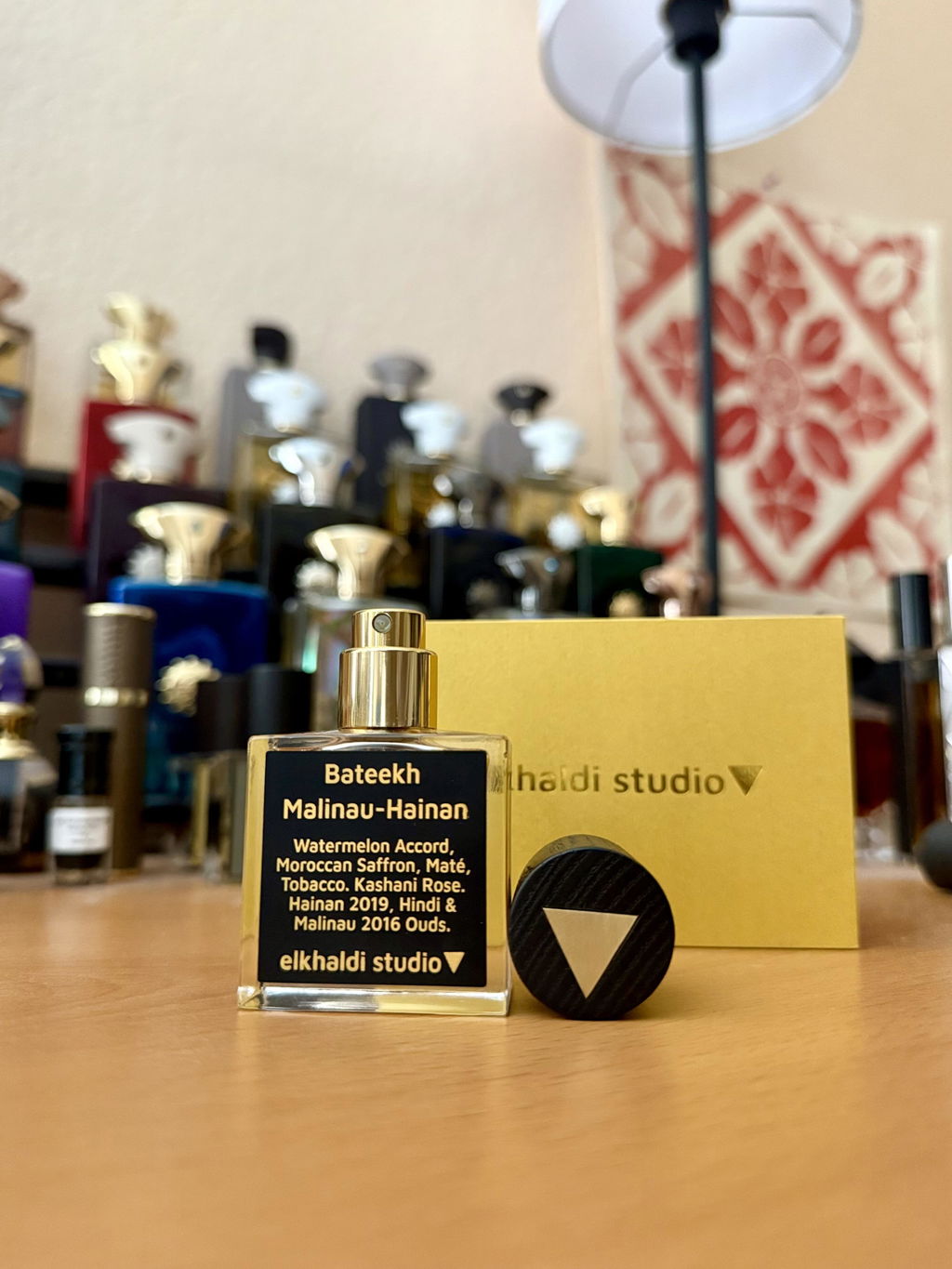
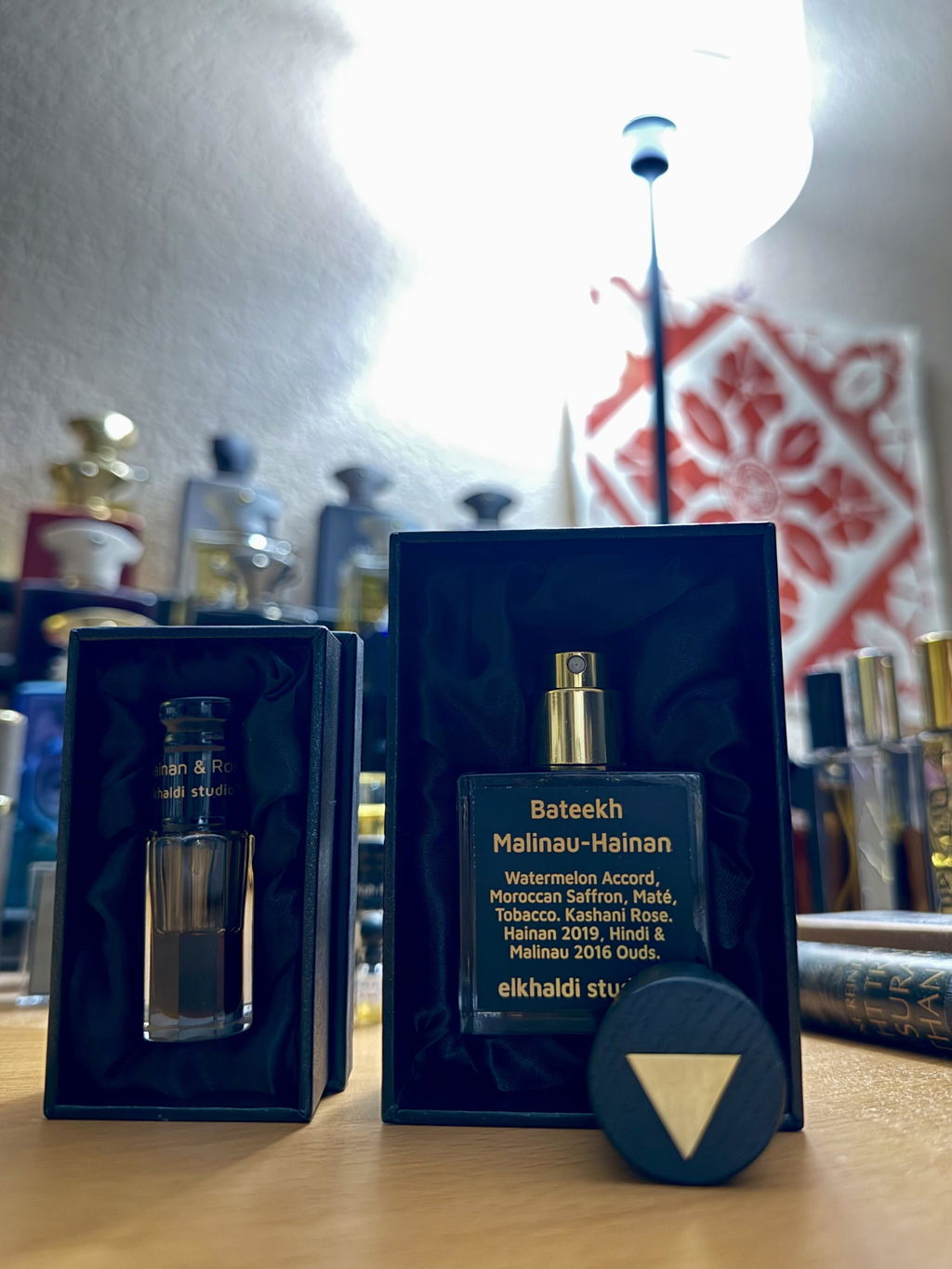
First off, I purchased the Bateekh with Malinau purely off convos with Maher. I have always loved the Malinau profile and never even thought of watermelon as a successful accord but I trust Maher’s nose entirely. On first spray I was blown away by the accuracy of this watermelon accord! Sweet but not cloying, fresh and juicy. Then the dry-down blew me away because it slowly worked its way down to the Malinau profile like a perfect match I had never imagined. Next thing you know the watermelon had morphed into beautiful Malinau woods that lasted on skin the whole day and on clothes for days!
How accurate was the description in your experience?:
Very different
Spot on
Hainan Rose is another rose gem by Maher
Hainan Rose is much rosier than the sample I received earlier. It opens with the Chinese Oud up front providing a beautiful greenness and within 45 mins, this massive juicy rose woke up and screamed for the next 5 hours. After this it is all Oudy goodness for hours and hours. This thing is loaded with both a ton of rose and a gallon of Chinese Oud.