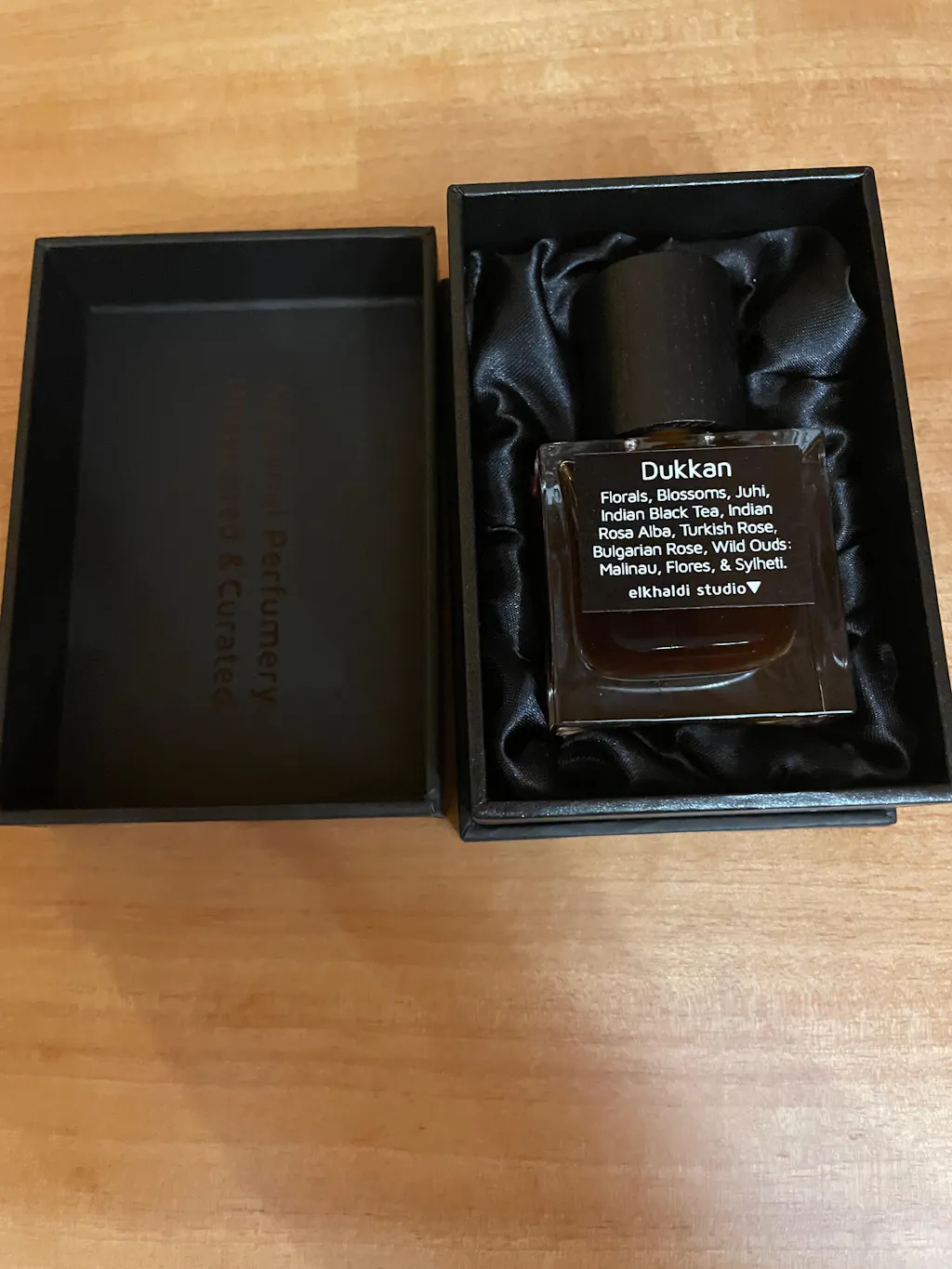
The last tobacco blend, Kasturi Cola — or as some affectionately called it, Cigar Cola — was quite a polarizing composition. Some fell in love with the entire arrangement. Others almost sang about individual notes they could pick out. A few found it too gourmand to wear. Such is the challenge of perfumery.
I was discussing this recently with a customer. One of the difficulties I find — and perhaps other perfumers do as well — comes from working with materials in their raw form. Sometimes you lose the ability to experience them the way others do. Or perhaps more accurately, you stop meshing them together in quite the same way. After years of smelling the raw materials, you become intimately familiar with their individual character, while customers encounter the finished composition as a whole.
Why did I gravitate towards Genres? And why are their formulas so elaborate—built like full compositions rather than simple accords?
The answer is interaction.
Materials don’t behave independently in a blend. Nothing is additive. Everything is contextual. Each addition reshapes perception—brightness, texture, diffusion, contrast. A material that seems minor on its own can rewrite how everything around it is read the moment it enters the structure. Formulation, then, is a system in motion. Every intervention changes the ground it stands on. You are not working inside fixed conditions. You are moving them as you go.
In perfumery, a Genre is infrastructure—an environment of interacting conditions rather than a fixed formula.
Some structures are too sparse to hold complexity. Introduce a material into a simple base, and it disappears or flattens. There is nothing for it to push against. But place it inside a Genre, and it meets resistance, contrast, and structure. It becomes legible through interaction.
This is why Genres are built like full compositions. They are not placeholders for ideas—they are complete fields designed to absorb change without collapsing.
Any blend built from a Genre carries that structure forward. The signature is already embedded—in the way tension holds, how contrast resolves, how space is carved.
A Genre is ultimately a strategy for reintroduction without repetition. A way to return to a familiar climate, introduce a new variable, and let both the system and the material reshape each other in real time.
This is the lure of Genres for me. They are more complex, more demanding to build, and carry higher risk—both in failure and in the risk of being constrained by their own internal logic. I don’t plan to build everything through this lens, but I think it is worth exploring in the next few projects.
For some reason, it’s widely accepted that consumers can demand suppliers be “neutral”—usually expressed as “stay out of politics.” I’ve outlined my view on this in Art with Bias, but recent conversations make me feel I should be more direct: I reject that fiction, especially at a time when official channels continue to suppress, ignore, or shut down voices that don’t align with power.
Neutrality risks becoming complicity, particularly when it is demanded by those uncomfortable with hearing the voices of the oppressed.
Art has never been neutral. Commerce has never been neutral. Media, design, and entertainment are all saturated with ideology, even when they claim otherwise. So no, I will not strip the politics from my reality. If that makes people uneasy, it should.
Recently, a few members of my small but growing community told me that some people had left my brand because I am “political.”
I expected it, but I am indifferent. In fact, through the lens of basic human dignity, I am glad.
I am glad my blends are not used to adorn their world—a world where justice is rationed to the powerful, and privilege is disguised as entitlement.
For me, this is not about comfort or convenience. It is about whether I am willing to bow to the pressure of profit, or to the expectations of those whose moral compass only functions within what is comfortable.
I sometimes wonder if those who argue for separating “politics and business” realize that taking a stance is itself political, just as much as refusing to take one.
Silence is a choice. Indifference is a choice. I made mine. Others can make theirs.
Yes, I have had customers leave. I have had social media accounts banned. I was let go from a job for my stance against war-for-profit and colonization. That is a price—but it is small compared to what is actually at stake. The cost of silence is far greater.
This is about refusing silence, and standing with a collective voice that is pushing against the erasure of Palestine.
Palestine was not “nearly forgotten.” The struggle did not begin in October 2023. It began over 75 years ago and has continued since—with more loss, more violence, more dispossession, and more denial. It is not a recent story.
I am open to discussion. We can talk history, theology, logic, and more. But if the expectation is my silence, then I have nothing further to say beyond this: you are welcome to explore the work of other perfumers.
For those who celebrate the independence of their state, I ask only this: do you also acknowledge the resistance that made it possible? Do you teach your children about the sacrifices of previous generations? Would you not speak against the exploitation or colonization of your own history?
I am not asking anyone to take a stance for Palestine. I am simply stating that I will not abandon mine.
If I have a voice, a platform, and the ability to speak, then, God willing, I will use it.
For me, Palestine is worth it.
EDIT Nov 11 2025.
I came across this short today, which I felt very much speaks to the same irony:
Maher
I was a kid who couldn’t stop creating — filling school books with drawings of TV cartoons, hearing a theme once and playing it perfectly on a keyboard, both hands, no training, just by ear. I sketched life-like portraits of my teachers in class and went home after hanging out with friends to recreate a meal I’d tasted at a tiny street food shop in Sharjah. I’ve always been driven by curiosity, trying to understand how sound, flavor, or form come together to create a complete experience.
That curiosity carried me into architecture, where my graduation project focused on decoding urban patterns and expressing them as abstract designs. I spent months observing how people moved through space, learning how structure can quietly shape experience in powerful ways.
Later, I pursued graduate studies in computational design and generative systems, where I learned how small changes can create wide variations, how complexity can be explored, organized, and refined, and how systems can be modeled from a user-interaction standpoint.
Taking those conceptual frameworks, I worked in startups and engineering teams across construction, automotive, and aviation. I had the opportunity to build tools for both large and small teams, for production operations as well as experimentation. This taught me the value of iteration: build, test, refine, repeat. I bring that same process to perfumery, where every release is a step toward a clearer, more precise expression of an idea.
That same mindset eventually drew me into perfumery. I started by buying artisanal blends and often felt the desire to add a few notes I thought they needed. That impulse to adjust and refine quickly became something deeper. I began studying raw materials, experimenting with structure, and realizing how even the smallest tweak could change the entire mood of a scent.
I view creating perfume as a problem-solving activity. I start with a goal inspired by an idea and explore different ways to reach it — sometimes taking the most direct path, and other times experimenting freely, with a subtle influence of optimization and search algorithms guiding my choices.
A blend might serve as an extensible base to be built upon or reinterpreted, or it might be a singular, self-contained composition designed to shift perception — taking the front row in one edition and the back row in another. I’ve tried to bring this modularity directly to the end user through X-editions on my website, creating a system of mass customization where each person can shape and explore their own experience. Each blend becomes a deliberate exploration within a framework — a balance of design, experimentation, and taste.
Even this website, elkhaldi.studio, reflects that mindset. I continuously rebuild and refine it — not just for design, but to make it a better reflection of how I work and think.
That’s my story.
Maher
Where:Personal / home , Small groups / personal space
When:Evening
Frequency?:Occasionally, Rarely / preserving it
How accurate was the description in your experience?:
Very different
Spot on
Kasturi Treat (Bright)
Maher outdid himself once again, just masterclass in perfumery here. To my surprise this is more so a gourmand perfume then musky-cola-tobacco what I was expecting. It opens with a faint cola note but the body of this perfume consists of nutty-chocolatey-coffee musk, underlying in a bed of tobacco. Also very easy to wear and to reach for.
Where:Everywhere, Personal / home , Small groups / personal space
When:Evening
Frequency?:Rarely / preserving it
Greatest Rose Oud Ever, No Debate
Pink tones, Green Tones, Purple Tones all dancing around in the air, it’s really a joy to experience. Slight sweetness that transforms into a Smokey/Oudy vibe that is simply regal. It feels thick on skin and stays around for hours making your day that much better. SOMS also made me appreciate Qinan Rose more. Just like someone above this review said, “this is the end all be all” when it comes to Rose Ouds. Job well done Maher!!
Where:Everywhere, Social / outings , Work / public
When:Anytime
Frequency?:Daily, Weekly
Cute rose
A slight sweet scent with a predominance of the rose accompained by a soft touch of jasmine. A light green shade of tea. Later i mainly perceive the Sylhet oud, wich i find consistent with the profile of the fragrance. In the late drydown, a soft and slightly oud base. Good job